
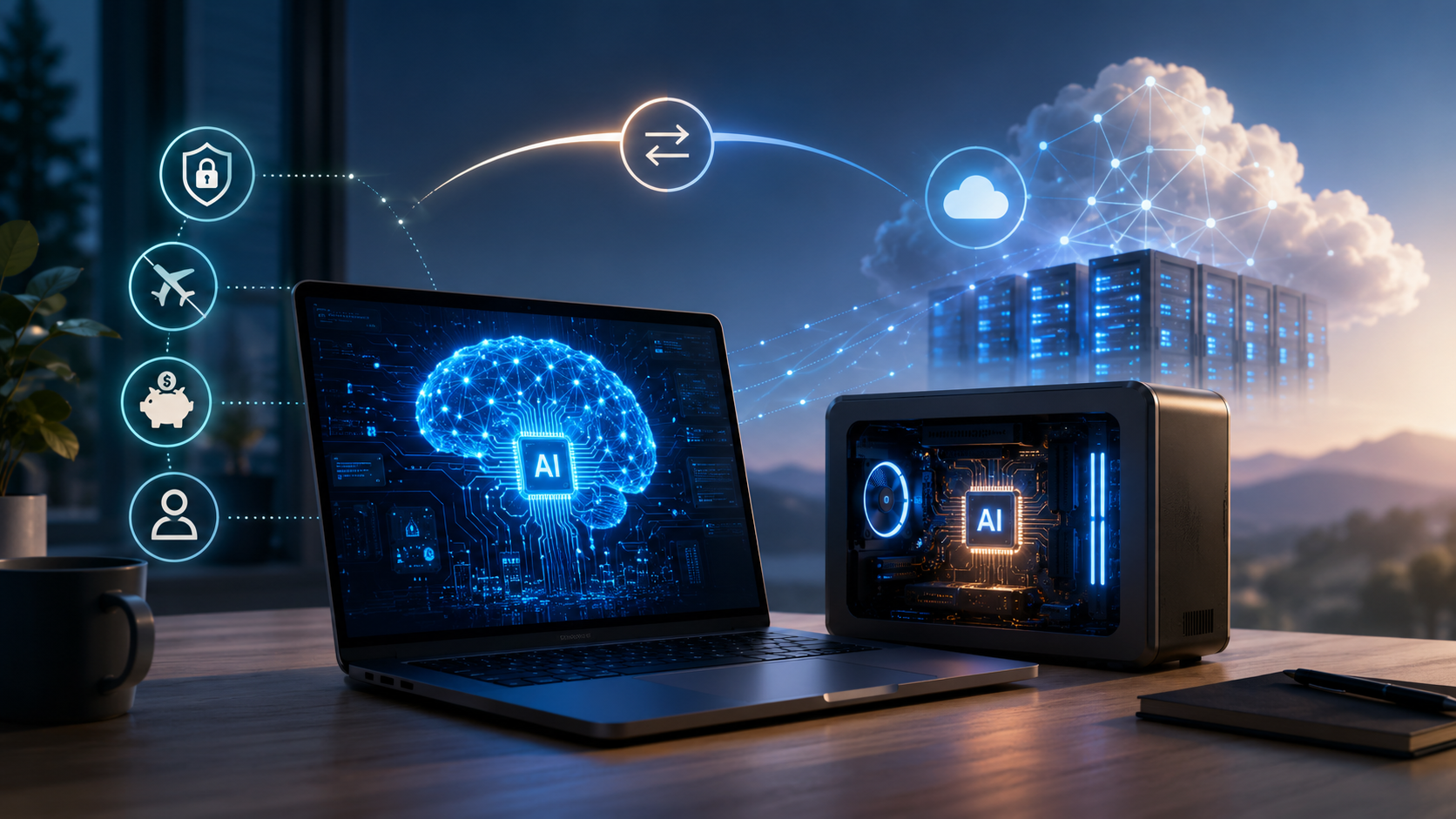
You don’t need a massive cloud AI model for every task. Local AI is getting good enough for everyday work like summaries, rewrites, notes, and brainstorming. It’s more private, works offline, and gives you more control.
Local AI models run entirely on your own device, meaning your prompts and documents never reach any external server or company.
Smaller local models now handle everyday tasks like email rewrites, document summaries, and brainstorming as effectively as major cloud AI services.
Local AI eliminates recurring subscription costs and keeps your workflows functional offline, making it a practical complement to cloud models like ChatGPT.
Cloud-based AI models like ChatGPT, Claude and Gemini have become the default way most people interact with artificial intelligence.
But there's a growing argument that many of those tasks don't actually require the most powerful AI models in the world.
In fact, for a surprisingly large percentage of everyday AI use cases, running a model directly on your own device may soon become the smarter option.
That's because in reality, most tasks people use AI for just aren't that complicated.
Rewriting emails, summarizing documents, organizing notes and brainstorming ideas can now be accomplished with a local AI model just as well as with a frontier state-of-the-art model.
Smaller models have improved dramatically over the past year, and many are now capable of handling these workflows with surprising effectiveness.
Local AI models run directly on your own computer instead of sending requests to a remote server.
Rather than uploading your prompts and files to a cloud provider, the model performs inference (the "thinking) on your hardware.
Historically, this required expensive equipment and significant technical expertise.
But that's beginning to change. As hardware improves and models become more efficient, running capable AI systems locally is becoming increasingly accessible.
One example is NVIDIA's recently announced RTX Spark platform, which combines CPU and GPU capabilities with up to 128GB of unified memory. Systems like this are designed specifically to make larger and more capable AI models practical to run directly on personal devices.
While hardware like this won't replace cloud AI entirely, it signals a broader shift toward distributing more AI workloads away from centralized infrastructure.
One of the biggest advantages of local AI is privacy.
When a model runs entirely on your machine, your prompts, documents, recordings, and conversations never leave your device. No AI company (or any company, for that matter) can see your messages or use them to train their own models.
For professionals handling sensitive information, or anyone who simply prefers greater control over their data, this is a huge benefit.
Cloud providers continue to improve their privacy practices, but local models remove many of those concerns altogether.
Cloud AI can be convenient...until you don't have internet.
Local models can continue operating on flights, in dead zones, remote locations and during network outages.
This might not be a daily necessity for most people. But when it does matter, it matters a lot.
With cloud AI, you either have to pay through a subscription, API pricing, usage limits, or some combination of all three.
With local AI, once the hardware is purchased, many workloads can be run repeatedly without paying for every individual request.
For developers, startups, and power users who generate large volumes of AI output, this could save a good amount of money.
The best AI models today are heavily concentrated within a small number of companies that control—and can change on a whim—the pricing, access, policies and rate limits.
With local models, you're less dependent on product decisions made by any single AI lab. If pricing changes, policies shift, or access becomes restricted, your local workflows remain available.
For some users, this level of autonomy is one of the biggest deal breakers for building with cloud AI.
Perhaps the most overlooked argument for local AI is its relationship to infrastructure.
The rapid growth of AI has triggered an equally rapid expansion of data centers around the world, which many people are concerned about for a variety of reasons.
Local AI isn't a complete solution to these concerns, but it does bypass them slightly. Every task performed locally is one less request traveling through a large centralized